
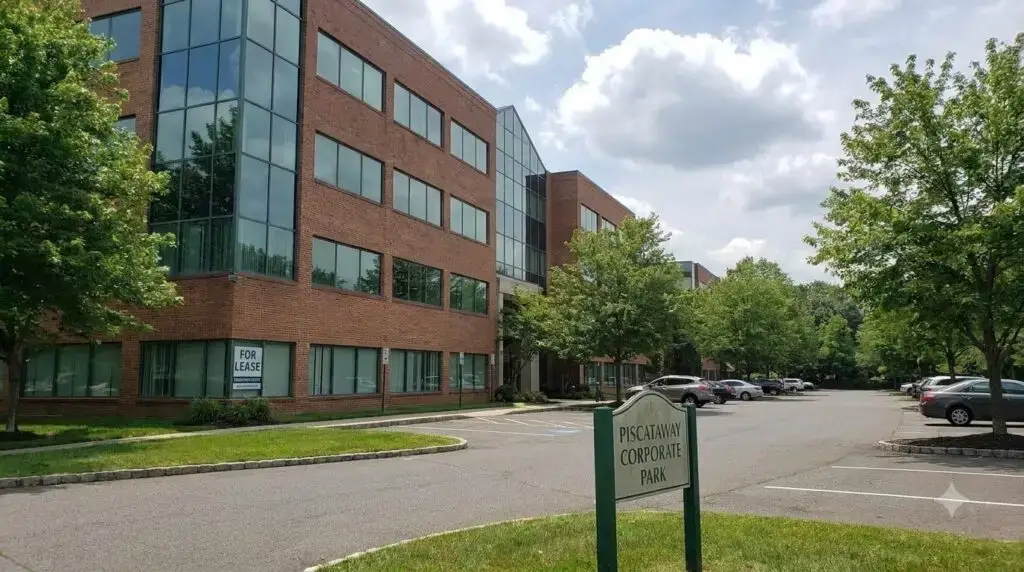
If you are researching office space cost in Piscataway, NJ, a useful 2026 starting benchmark is approximately $21 per square foot per year for traditional office space.
CommercialCafe, using Yardi Research Data, reports an average Piscataway office asking rent of about $21/SF/YR, with currently tracked local listings ranging roughly from $20 to $24/SF/YR.
That means a business comparing office options can use $21/SF/YR for an initial budget, but it should not assume every Piscataway office will cost exactly that amount.
At $21/SF/YR, approximate base rent would look like this:
| Office Size | Annual Base Rent | Monthly Base Rent |
| 500 SF | $10,500 | $875 |
| 1,000 SF | $21,000 | $1,750 |
| 2,000 SF | $42,000 | $3,500 |
| 3,000 SF | $63,000 | $5,250 |
| 5,000 SF | $105,000 | $8,750 |
| 10,000 SF | $210,000 | $17,500 |
But this table answers only one question:
What is the base rent?
It does not necessarily answer:
What will the office actually cost my business each month?
Depending on the lease, your total occupancy cost may also include electricity, operating expenses, insurance, internet, parking, furniture, improvements and other charges.
Before comparing offices, understand exactly what is included in each quoted rate.
What Does “$21 Per Square Foot Per Year” Mean?
Commercial office rent is commonly advertised as:
$/SF/YR
That means dollars per square foot per year.
The basic calculation is:
Office size × annual rate per square foot = annual base rent
Then:
Annual base rent ÷ 12 = monthly base rent
Example: 2,500 SF Office
Suppose you find a 2,500 SF office listed at $21/SF/YR.
2,500 × $21 = $52,500 per year
Then:
$52,500 ÷ 12 = $4,375 per month
Your estimated base rent is therefore $4,375 per month.
That does not automatically mean your total monthly office cost will be $4,375. The lease may allocate other expenses separately.
What Is the Average Office Rent in Piscataway in 2026?
Current CommercialCafe/Yardi market data places average Piscataway office rent at approximately:
$21/SF/YR
Among listings tracked by the platform, the current range is approximately:
$20–$24/SF/YR
Individual properties can still fall outside that range, especially when data sources, lease structures, building types or listing dates differ.
For that reason, $21/SF/YR should be used as a market benchmark, not as a guaranteed quote.
The cost of a specific suite will depend on the building, condition, location, lease terms and what expenses are included.
Why Office Rents Differ Across Piscataway
A 3,000 SF office in one building may have a very different cost from a 3,000 SF office only a few minutes away.
Several factors can move the price.
1. Building Class
Piscataway’s traditional office market is heavily concentrated in Class B space.
According to 2026 CommercialCafe/Yardi data:
- Class A: approximately 4.81% of inventory
- Class B: approximately 87.43%
- Class C: approximately 7.76%
The same data places average Class B office rent around $21/SF.
Building class is not the only measure of quality, but it can influence rent because buildings differ in age, renovations, amenities, systems, location and overall condition.
2. Location Within Piscataway
Location within the same city can change pricing.
CommercialSearch identifies I-287 South as the Piscataway area with the greatest concentration of listed office opportunities and reports an average asking rent of approximately $25.08/SF for that submarket.
Access to major roads can matter to companies whose employees or clients travel throughout Central New Jersey.
Businesses should evaluate access to routes such as:
- I-287
- New Jersey Turnpike
- Garden State Parkway
- Route 27
- surrounding employment centers
A slightly higher rent may make business sense if the property significantly improves commuting, parking or client access.
3. Office Condition and Existing Build-Out
The lowest asking rate does not always create the lowest first-year cost.
Consider two hypothetical offices.
Office A
- Lower rent
- Needs new flooring
- Needs walls constructed or removed
- Requires electrical work
- Requires new furniture
- Requires significant IT setup
Office B
- Higher asking rent
- Already built out
- Private offices exist
- Conference room exists
- Wiring is usable
- Furniture may already be available
Office A may look cheaper on a listing website while requiring considerably more cash before your team can move in.
Always compare occupancy cost, not simply headline rent.
4. General Office vs. Medical Office
Medical space can have different pricing because medical users may require:
- exam rooms
- plumbing
- specialized electrical infrastructure
- patient reception areas
- sinks
- additional build-out
- specialized code or operating requirements
Do not use the asking price of a medical suite as a direct benchmark for a conventional software, accounting, consulting or professional-services office.
5. Lease Structure
Lease structure can completely change what a quoted rate means.
Two offices might both advertise:
$20/SF/YR
but produce different actual monthly bills.
That is why businesses should compare the expenses included in the lease rather than comparing the headline rate alone.
Full-Service vs. Modified Gross vs. NNN Office Leases
Commercial leases can allocate operating expenses between landlord and tenant in different ways.
Exact definitions and inclusions can vary by lease, so the written lease controls.
Full-Service Lease
A full-service or full-service-gross office lease generally includes more building operating expenses within the quoted rental structure.
Depending on the lease, these may include some combination of:
- property taxes
- building insurance
- common-area expenses
- janitorial services
- utilities
However, “full service” does not necessarily mean every business expense is included.
Electricity, telecom, after-hours HVAC, parking or expense increases may still be treated separately.
Modified Gross Lease
Under a modified gross structure, landlord and tenant divide expenses according to the negotiated lease.
Some expenses may be included in the quoted rent while others remain the tenant’s responsibility.
This makes it especially important to request a clear expense breakdown.
Triple-Net or NNN Lease
Under a typical NNN structure, a tenant pays base rent plus additional property-related expenses, commonly including allocations for:
- property taxes
- insurance
- common-area maintenance
The important lesson is simple:
Compare what you will pay, not merely what the lease is called.
What Are CAM Charges?
CAM means Common Area Maintenance.
When CAM is separately charged, it generally relates to expenses associated with operating and maintaining shared areas of a commercial property.
Depending on the lease, those expenses may involve items such as:
- lobbies
- hallways
- elevators
- landscaping
- parking areas
- common restrooms
- exterior maintenance
- other shared building services
Never assume that every property calculates CAM the same way.
Before signing a lease, ask:
- What expenses are included in CAM?
- How is my share calculated?
- Are taxes and insurance separate?
- Can CAM increase during the lease?
- Are there caps on controllable expenses?
- Are any capital expenses passed through?
- Which utilities are billed separately?
These questions can be worth far more than negotiating a small difference in headline rent.
Base Rent Is Only Part of Your Office Budget
A realistic office-space budget should include both recurring costs and one-time move-in costs.
Recurring Office Costs
Depending on the lease, these may include:
- Base rent
- CAM or operating expenses
- Electricity and utilities
- Internet and telecom
- Business insurance
- Parking
- After-hours HVAC
- Other recurring lease charges
One-Time or Upfront Costs
A move can also require:
- Security deposit
- Furniture
- Moving expenses
- IT installation
- Cabling
- Equipment setup
- Paint or flooring
- Office construction
- Legal or professional fees
- Other agreed lease deposits
A cheaper rental rate can lose its advantage quickly if your business must spend heavily to make the office usable.
How to Calculate Your True Monthly Office Cost
Do not stop at:
“What is the rent?”
Instead calculate:
Monthly Base Rent
+ Operating Expenses or CAM, if separately charged
+ Utilities
+ Internet / Telecom
+ Insurance
+ Parking
+ Other Recurring Lease Charges
= Estimated Monthly Occupancy Cost
Then calculate one-time costs separately.
This gives management a much better number for financial planning.
Why a Lower Asking Rent Is Not Always the Better Deal
Suppose your business is comparing two hypothetical 3,000 SF offices.
Office A
Base rent:
$17/SF/YR
Monthly base rent:
$4,250
But the tenant must separately pay multiple operating expenses and complete a substantial build-out.
Office B
Base rent:
$21/SF/YR
Monthly base rent:
$5,250
But the office is already built out and more building expenses are included.
Office A appears to save $1,000 per month when you compare only base rent.
Once operating expenses, improvements, furniture and other costs are included, the financial difference may become much smaller.
The lower headline rate may still be the better choice, but you cannot know that until you compare both deals on the same basis.
Does the Landlord Offer a Tenant Improvement Allowance?
Another factor that can affect your real office cost is a tenant improvement allowance, often called a TI allowance.
A landlord may agree to contribute toward certain improvements required for a tenant’s space.
Depending on the negotiated agreement, those improvements might involve items such as:
- walls
- flooring
- paint
- electrical work
- office configuration
- other approved construction
TI allowances are not universal, and the amount and structure vary by property and lease.
When comparing two offices, ask:
How much of the required build-out will the landlord fund, and how much will our business pay?
A property with a higher rent but meaningful landlord-funded improvements can sometimes produce a better overall deal than a lower-rent space requiring substantial tenant-funded work.
Do Not Ignore Annual Rent Increases
The rent you pay in Year 1 may not be the rent you pay throughout the lease.
Suppose a hypothetical office starts at:
$5,000 per month
and the lease contains a hypothetical 3% annual increase.
| Lease Year | Monthly Base Rent |
| Year 1 | $5,000 |
| Year 2 | $5,150 |
| Year 3 | $5,304.50 |
This is only an illustration, not a standard escalation rate.
Your actual lease may use a different structure.
Before signing, ask:
How and when does the rent increase?
For a multi-year lease, compare the total cost over the full term, not only the first month’s rent.
What Does Office Space Cost at 15 Corporate Place South?
For businesses comparing actual Piscataway properties, 15 Corporate Place South provides a useful real-world example.
A current LoopNet listing checked on August 27, 2026 shows multiple suites at $15/SF/YR.
The listing also displays:
$1.25/SF/MO
This is the monthly equivalent of the $15 annual rate:
$15 ÷ 12 = $1.25 per square foot per month
It should therefore not be added to $15/SF/YR as a separate CAM charge.
The listing states that the advertised lease rate is plus a proportional share of electrical cost.
Because listing information and availability can change, tenants should confirm the current rate and expense structure directly in the latest leasing proposal.
Current 15 CPS Base-Rent Examples
Using a $15/SF/YR advertised rate:
| Suite Size | Approx. Annual Base Rent | Approx. Monthly Base Rent |
| 600 SF | $9,000 | $750 |
| 650 SF | $9,750 | $812.50 |
| 1,550 SF | $23,250 | $1,937.50 |
| 1,600 SF | $24,000 | $2,000 |
| 2,320 SF | $34,800 | $2,900 |
| 3,400 SF | $51,000 | $4,250 |
| 15,500 SF | $232,500 | $19,375 |
| 17,500 SF | $262,500 | $21,875 |
These figures represent base-rent planning calculations, not final lease quotes.
Electricity and any other expenses specified in the final lease should be added before setting an occupancy budget.
Current listings also show that availability can change substantially over time, so businesses should check the latest suite inventory rather than relying on an older availability list.
How Does 15 CPS Compare With the Piscataway Market Benchmark?
Piscataway’s 2026 office asking-rent benchmark is approximately:
$21/SF/YR
Current 15 CPS listings referenced above advertise:
$15/SF/YR
At first glance, this places the advertised base rate below the citywide benchmark.
But this should not be interpreted as a guaranteed percentage savings.
Why?
Because different market data and individual property listings may use different:
- lease structures
- expense treatments
- square-footage measurements
- property classes
- build-out conditions
- dates
- utility arrangements
The correct comparison is:
Total expected occupancy cost for Property A
versus
Total expected occupancy cost for Property B
not simply:
$15 vs. $21
How Does Piscataway Compare With the Broader New Jersey Office Market?
For broader context, JLL’s Q2 2026 Northern and Central New Jersey office-market report lists:
Overall direct asking rent: $32.40/SF
Class A direct asking rent: $35.31/SF
Piscataway’s approximately $21/SF local benchmark is below those broader figures.
However, this is not a perfect apples-to-apples comparison.
The datasets cover different property mixes, classes and geographic areas.
The more useful conclusion is that Piscataway can offer businesses a different cost profile from many higher-priced parts of the broader Northern and Central New Jersey office market.
How Much Should a 10-, 20- or 50-Person Business Budget?
Your rent depends on how much office space your team actually needs.
As a simple planning illustration, suppose a business uses approximately 150 square feet per peak in-office employee.
Using the Piscataway citywide benchmark of approximately $21/SF/YR:
| Team Size | Approx. Office Size | Approx. Monthly Base Rent |
| 5 employees | 750 SF | $1,313 |
| 10 employees | 1,500 SF | $2,625 |
| 20 employees | 3,000 SF | $5,250 |
| 30 employees | 4,500 SF | $7,875 |
| 50 employees | 7,500 SF | $13,125 |
These are base-rent illustrations only.
Your company may need more or less space depending on:
- hybrid attendance
- private offices
- conference rooms
- reception
- storage
- collaboration areas
- specialized equipment
- future hiring
Determine how much office space your team actually needs before turning rental rates into a final budget.
Seven Questions to Ask Before Comparing Piscataway Office Quotes
Before deciding which office is cheaper, get clear answers to these questions:
- What is the base rent per square foot per year?
- Is the advertised area usable square feet or rentable square feet?
- What expenses are included in the quoted rent?
- What CAM or operating expenses are charged separately?
- Which utilities are the tenant’s responsibility?
- How does rent increase during the lease?
- What improvements, furniture or move-in costs will the tenant pay?
Then ask one final question:
What should our business realistically budget each month after every recurring occupancy charge is included?
That number is far more useful than the headline rental rate.
Is the Cheapest Office Space in Piscataway the Best Deal?
Not automatically.
Price matters, but value also depends on what the office allows your business to avoid paying for elsewhere.
Compare factors such as:
- existing build-out
- furniture
- parking
- commute
- highway access
- electrical capacity
- data infrastructure
- conference rooms
- property management
- expansion flexibility
- move-in readiness
15 Corporate Place South, for example, is marketed with features including heavy power, advanced wiring, surface parking, three elevators and shared loading access.
For professional and technology-oriented companies, infrastructure like this can have economic value even though it does not appear in a basic price-per-square-foot comparison.
Location Can Affect the Real Value of Your Rent
15 Corporate Place South is located in Piscataway Corporate Park with access to major Central New Jersey road networks.
For businesses employing people from areas such as Edison, New Brunswick, Bridgewater and other Central Jersey communities, accessibility can affect more than convenience.
Location can influence:
- employee commute times
- recruiting
- visitor access
- parking expense
- client travel
- employee retention
The cheapest lease does not necessarily create the lowest overall business cost.
Frequently Asked Questions
What is the average office space cost in Piscataway, NJ?
Current 2026 CommercialCafe/Yardi data places average Piscataway office asking rent at approximately $21 per square foot per year.
Individual properties can price above or below that benchmark.
How much does a 1,000 SF office cost in Piscataway?
At $21/SF/YR:
1,000 × $21 = $21,000 per year
or approximately:
$1,750 per month in base rent
Additional expenses depend on the individual lease.
How much does a 3,000 SF office cost in Piscataway?
At the approximately $21/SF/YR citywide benchmark:
3,000 × $21 = $63,000 per year
or:
$5,250 per month in base rent
That figure does not include separately charged occupancy expenses.
What does $15/SF/YR equal per month?
Divide the annual rate by 12:
$15 ÷ 12 = $1.25/SF/month
For a 3,000 SF office:
3,000 × $1.25 = $3,750 per month in base rent
What is CAM in an office lease?
CAM means Common Area Maintenance. When charged separately, it generally relates to costs associated with operating and maintaining shared areas of a commercial property.
The exact definition and allocation depend on the lease.
Does full-service office rent include everything?
Not necessarily.
A full-service structure generally includes more operating expenses than a net lease, but electricity, telecom, parking, after-hours HVAC or other costs may still be treated separately.
Always review the actual expense provisions.
Is office space in Piscataway cheaper than the New Jersey average?
Piscataway’s approximately $21/SF local office benchmark is below JLL’s Q2 2026 broader Northern and Central New Jersey overall direct asking-rent figure of $32.40/SF.
Because the datasets cover different property mixes and geographic areas, the figures should be used as market context rather than as a direct property-to-property comparison.
What should I ask for before signing an office lease?
Ask for a clear breakdown showing:
- base rent
- included expenses
- separately charged operating costs
- utilities
- parking
- annual increases
- improvement obligations
- required deposits
- expected recurring monthly cost
This makes it much easier to compare competing properties fairly.
What Should You Budget for Office Space in Piscataway?
For early-stage planning in 2026, approximately $21/SF/YR is a useful Piscataway office-market benchmark.
But your calculation should not stop at the market average.
Start with:
Required Office Size × Base Rental Rate
Then add any separately applicable:
- operating expenses
- utilities
- telecom
- insurance
- parking
- other recurring lease charges
Finally, account for one-time expenses such as:
- furniture
- moving
- IT setup
- deposits
- tenant-funded improvements
That gives your business a much more useful answer to:
“How much does office space cost in Piscataway, NJ?”
For businesses considering 15 Corporate Place South, current listings checked in August 2026 show office space advertised at $15/SF/YR, with the listing noting a proportional share of electrical cost.
Because rates, suites and lease terms can change, the final step should be to review current available suites and request an up-to-date lease quote based on the exact size your business needs.